

Similar to other industries, medical product manufacturers are always looking to reduce costs, improve the quality of their products, and extend lifetime performance. The focus on long-term cost and price stability has a direct effect on manufacturers’ sales revenue and profits.
The medical device market requires a lot of skill and research, especially in the areas of material selection and manufacturing processes.
In the medical industry, material performance can be the difference between health and injury. Consequently, whether you evaluate metal, plastic, ceramic, or Liquid Silicone Rubber (LSR) for your medical device, the most important aspect to consider concerns the compatibility of the material with the functionality the equipment requires.
When it comes to choosing materials for new medical equipment and devices, engineers need to consider a variety of factors, including biocompatibility, qualification, regulation, and cost. For silicone medical devices, many applications require components that can withstand a variety of tough conditions, such as heat, high pressure, chemical exposure, and biocompatibility.
Until LSR came along, medical device manufacturers had a difficult time finding materials that met their criteria for custom silicone-molded components and assemblies. Medical-grade silicone molding lends itself to dental and surgical dental applications, consumer health care products, and other medical products and devices.
READ OUR LSR IN THE MEDICAL INDUSTRY GUIDE
WHAT IS LIQUID SILICONE RUBBER (LSR)?
Over the last hundred years, material innovations in basic and specialty elastomers have led to a range of materials that are suitable for a broad range of applications and operating environments. The materials vary in terms of key characteristics, such as elasticity, strength, hardness, compatibility, temperature range, environmental resistance, and other properties.
One of these materials, LSR, which has been around since the 1970s, continues to make the transition to becoming the premier material for the manufacture of medical products and devices. LSR consists of a highly flexible thermosetting plastic that comes in a broad range of compositions and hardness.
The variety of LSR materials allows product designers and engineers to select the material with the characteristics most appropriate for the application.
At room temperature, thermoplastic begins as a solid material, which softens when you heat or reheat the material above its melting point. In comparison, thermosetting materials start out in liquid form, and the heat cures the resin into a solid state. Once it cures, the part remains solid — a feature that helps make LSR the ideal material choice for numerous medical applications.
The key attributes of LSR include:
- Hardness
- Tensile strength
- Compression set
- Fluid resistance
The benefits of medical-grade LSR over elastomeric materials include:
- Bio-inert material in compliance with ISO 10993, USP Class VI, and RoHS standards
- Ability to be sterilized with a variety of methods such as Autoclave, ETO, E-beam, and Gamma radiation processes
- Low viscosity that allows flow to all parts of the mold
- Excellent stability over a broad range of temperatures, 150°F to 450°F
- Low compression set
- Self-adhesive LSR that chemically adheres to plastics without the need for priming
- Ability to maintain its resiliency, flexibility, and capability to transfer mechanical force at extreme temperatures
LSR has superior electrical insulating qualities even under the most severe environmental conditions. The manufacturer can acquire mold cavities specifically tailored to achieve different surface textures for parts and products.
THE IMPORTANCE OF MEDICAL-GRADE LIQUID SILICONE RUBBER
Dr. Frank Lahey receives credit for the first-known use of elastomeric silicone to repair a patient’s bile duct in 1946. Lahey was attracted to the material because of its stability and elasticity, which allow the material to be cast into virtually any shape.
Today, a variety of silicone materials meet the standards for medical device manufacturers, including medical non-implantable, medical restricted-implantable, and medical unrestricted-implantable.
One of the primary reasons silicone has developed into a key material for medical applications has to do with the biocompatibility of the material and the ability to use it in a broad array of lifesaving medical devices, such as pacemakers and hydrocephalic shunts.
Innovations in material science have made non-implantable materials more commonly available in a variety of durometers. This makes it possible to fabricate medical devices of varying hardness levels.
Non-implantable-grade LSR for mold-making can come into contact with the skin, but not the inside of the body. Medical silicone rubber must undergo specific safety testing and evaluation.
ISO 10993 provides a multipart standard used worldwide to evaluate the biosafety of this material. LSR meets the criteria as outlined by ISO 10933 for use in medical applications.
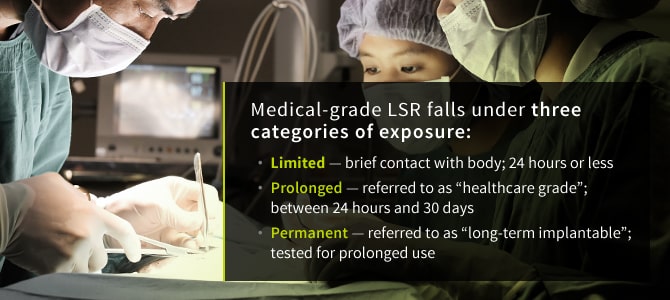
Medical-grade LSR falls under three categories: limited exposure, prolonged exposure, and permanent contact.
- Limited exposure: For devices that will come into contact with skin, mucosal membranes, or compromised and breached surfaces, this category has a brief service life of 24 hours or less.
- Prolonged exposure: This material, referred to as “healthcare grade,” is based on tests such as hemolysis, genotoxicity, toxicity, and intramuscular implantation with histopathology. This material has a surface or implant contact of more than 24 hours and up to 30 days.
- Permanent contact: Also known as “long-term implantable,” this medical silicone rubber must undergo physicochemical and biological testing that exceeds the testing protocols for prolonged exposure, including carcinogenicity, chronic toxicity and developmental toxicity.
If you have a new or existing application that requires any type of housing, valve, dampener, gasket, seal, coupler, or membrane button — uses that could benefit from inertness, low compression set, or temperature resistance — could realize substantial benefits from medical LSR medical-grade liquid silicone.
THE ADVANTAGES OF MEDICAL-GRADE LSR OVER ALTERNATIVE MATERIALS
Medical-grade LSR approved for medical applications where it will come into contact with skin has tremendous stability and is water-repellent, which prohibits cured material from being affected by contact with skin. Unlike materials such as latex, LSR is non-allergenic, so the material does not affect the skin.
The hygienic quality of LSR helps it to resist the growth of bacteria and fungi. LSR has the inherent qualities of flexibility and softness, which ensure the patient’s comfort. The water-repellant characteristics prevent the material from sticking to wounds.
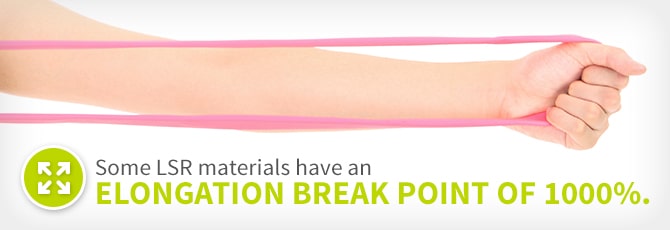
LSR can not only tolerate heat, but it also remains extremely elastic at very low temperatures. The flexibility of the material depends upon the nature of the compound, but it is typically very high. For example, some LSR materials have an elongation break of 1000 percent.
LSR also has a low compression set or low permanent deformation upon the application or removal of force. LSR also withstands ultraviolet radiation well. The stability of the cured part prolongs the product’s shelf life.
While many designers compare LSR to thermoplastic elastomers (TPEs) like Santoprene™, LSR has developed a reputation as “TPE on steroids.” LSR costs more than other resins. The material also has a longer cycle time for the molding process compared to other thermoplastics.
However, LSR allows you to combine multiple components and reduce the cost of production runs. Nonetheless, the overall capabilities of LSR make it a smart choice for many medical device applications.
The benefits of selecting medical-grade LSR over other options include:
- FDA biocompatibility
- Resistance to chemical and bacteria
- Excellent transparency, which allows light transmittance and illumination
- Gas permeability
- Clarity
- High elongation
- Superior dielectric strength
- Superior tensile strength, elongation, tear strength, and compression at temperature extremes
- Ability to function in extreme temperatures
- Low compression set at wide temperature ranges
Compared to high-consistency rubber (HCR) and other elastomers, LSR makes a better material choice for manufacturing high-precision medical components and devices with detailed geometries that require high accuracy.
MEDICAL DEVICES MANUFACTURED USING LSR INJECTION MOLDING
The material used to fabricate medical devices consists of LSR. Some components may require multiple molding processes, which requires a thorough evaluation of different manufacturing variables, such as product life cycle, production volume, part geometry, and material type.
The liquid injection molding process requires the mixing of two parts of LSR in a static mixer before transference to the screw. The screw forces the material into the mold in a certain shot size. This process often automates LSR molding of quality parts at a high volume.
Product designers choose LSR for the design and manufacture of medical silicone parts and devices for a broad range of applications. Specialty medical fields that use LSR medical injection molding include:
- General surgery
- Cardiology
- Oncology
- Bariatric surgery
- Plastic surgery
- Ophthalmology
- Wearable health monitoring devices
- Dialysis
- Neurosurgery
- Ear, nose, and throat
When choosing a material for your project, the cost of LSR may become a sticking point. Unfortunately, many medical products and device manufacturers make a strategic decision to compromise on product design and performance so they can save money on up-front tooling costs.
However, the selection of medical-grade LSR pays off in the form of improved quality and better performance.
Over the long run, medical products and devices molded from LSR can withstand the most challenging conditions.
OVER-MOLDING MEDICAL DEVICES WITH LSR
The medical market and healthcare industry require materials and processes that will allow manufacturers to create a product with tighter tolerances, sterilization capabilities, and soft-touch surfaces and colors.
Over-molding describes a manufacturing method that adds another layer of material over an existing part. The process goes by other names, such as multi-shot, double-shot, hard/soft overmolding, twin-shot molding and 2K molding. The technique has taken root as a viable manufacturing process in the medical industry as product-makers realize the tremendous benefits.
Over-molding is an injection molding process that has drastically changed the aesthetics, design, and functionality of medical products over the last few years.
Surgeons and other clinicians have become more enthralled with devices and surgical instruments that have soft-touch handles, which improve the grip. Over-molding allows for the fabrication of handles into an ergonomic shape that fits into the hands of the end user or interacts with attachments.
The molder starts by overmolding a shaft of metal with LSR to form the desired shape. The molder uses thermoplastic to create the soft-touch handle.
The process allows product designers to create parts with seamless surfaces and no gaps, which eliminates traps for contaminants. The transparency of LSR material allows the surgeon to see through the instrument and work with more precision.
The over-mold method has increasingly grown as a viable process in the medical market because more device-makers realize its potential advantages.
This process works well for products or devices that require handles, biocompatibility, heat resistance or chemical resistance. Some soft thermoplastics, such as TPE, can replicate some of the characteristics, but LSR has attributes that far outweigh the properties of other materials, including durability, biocompatibility, cold and resistance to heat, chemicals and UV light. LSR also has unparalleled flexibility and moldability.
COST SAVINGS MANUFACTURING WITH LSR
Product designers come under increasing cost pressure, which means they must be more creative.
Consequently, the mantra is to mold as much functionality into the part as is feasible, while simultaneously minimizing material cost, secondary processes, and assembly.
The part serves as the skin and a structural member of the frame. For surgical instrumentation, overmolding over plastic and metal has become preferable to machining an entire instrument from metal or alloys.
Product manufacturers can reduce costs by overmolding silicone onto a metal piece, using metal only where it is functionally required, such as at a cutting edge, while molding the remainder of the instrument in plastic and/or LSR. Over-molding, two-shot (2K), and multi-shot molding can deliver additional cost savings by molding multiple materials within a single molding process. This integrated approach eliminates the need for secondary operations such as bonding, gluing, assembly, or joining, reducing time and costs, and minimizing quality risks and contamination concerns associated with these additional processes.
Beyond cost and manufacturing efficiencies, these advanced molding technologies support the growing demand for smaller, more sophisticated medical devices. As device designs become increasingly compact and complex, LSR injection molding enables the production of intricate geometries, tight tolerances, and highly integrated components while maintaining the consistency required for high-volume manufacturing. This combination of design flexibility and production efficiency allows medical device manufacturers to bring products to market more quickly and cost-effectively.
As a result, overmolding and 2K molding processes provide a more efficient manufacturing solution that lowers overall production costs, enhances product quality, simplifies assembly, and expands design possibilities for next-generation medical devices.
Frequently Asked Questions
We’ve answered the most common questions medical device manufacturers evaluating LSR commonly ask about grade classifications, sterilization compatibility, and the components the process supports.
What Is the Difference Between Medical-Grade LSR and Standard LSR?
Medical-grade LSR differs from standard LSR in its curing system and its biocompatibility documentation. Medical grades use a platinum cure that leaves no acidic byproducts, then undergo evaluation against ISO 10993, USP Class VI, and RoHS. Standard grades meet mechanical requirements without that biological testing, so they are not qualified for parts that contact skin, mucosal tissue, or the bloodstream.
Is Medical-Grade LSR Hypoallergenic?
Yes, medical-grade LSR is hypoallergenic. Its inorganic backbone is free of the proteins that make latex a common allergen, so cured parts do not provoke a reaction on contact with skin. Medical-grade LSR is also odorless, tasteless, and hydrophobic, which keeps parts stable in moist environments and prevents them from adhering to wounds.
What Sterilization Methods Can Be Used on Medical-Grade LSR?
Medical-grade LSR can be sterilized by autoclave, ethylene oxide, e-beam, and gamma radiation. Its thermal stability supports repeated steam cycles without deformation, which suits reusable instruments. Gamma and e-beam radiation can change crosslink density and alter mechanical properties, so validate your chosen method against the specific LSR grade, part geometry, and expected service life before production.
Can Medical-Grade LSR Be Used in Implantable Medical Devices?
Yes, LSR grades qualified for permanent contact are used in implantable devices, including pacemaker components and hydrocephalic shunts. Long-term implantable grades undergo physicochemical and biological testing beyond prolonged exposure protocols, covering carcinogenicity, chronic toxicity, and developmental toxicity. Confirm the grade classification and the ISO 10993 testing your application requires before design freeze, since implant suitability depends on contact duration and part geometry.
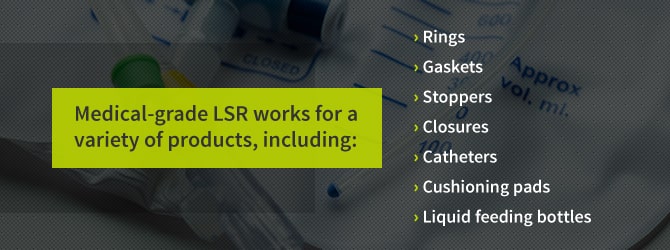
What Medical Device Components Are Commonly Manufactured Using LSR Injection Molding?
LSR injection molding is widely used for silicone seals, duckbill valves, membranes, diaphragms, bellows, septa, trocar components, plunger tips, pump housings, respiratory masks, and hearing aid ear tips. LSR 2-shot molding combines these parts with a thermoplastic or metal substrate in a single process, eliminating assembly steps and gaps where contaminants collect. SIMTEC molds these components in ISO Class 7 and Class 8 clean rooms.
MEDICAL-GRADE LSR CAN GIVE YOUR PRODUCT A COMPETITIVE EDGE
The ever-evolving and highly innovative nature of the medical industry makes it necessary to have a material like medical-grade silicone rubber to fabricate products ranging from tubing to lifesaving healthcare devices.
The high degree of repeatability by applying high-quality molding methods and automation, as well as the ability to automate the process and the production of flash-less products, lends itself to high-volume production.
At SIMTEC, our sole focus is LSR. We have the technology, automation, and expertise to manufacture precision components in quantities from hundreds of thousands of parts per year and scaling to multi-million parts per year.
SIMTEC’s Miramar, Florida, manufacturing facility is ISO 9001, ISO 13485, and IATF 16949 certified. This means we adhere to a set of certified, repeatable processes so that each part we produce meets the highest industry standards.
We have one of the lowest defect rates in the industry, and we can customize a QA plan to reflect your specific part specifications and regulatory requirements.
Our Class VIII (100,000) clean room is also available to meet strict hygienic requirements, limiting exposure to dust and other airborne particles. If you require high-volume, custom products made using medical-grade silicone and robust high-capacity molds for production of consistent, high-quality molded parts, SIMTEC is here to help – from optimizing your part design and molded prototypes for clinical testing through full-scale LSR, LSR two-shot, and LSR over-molded components.
To learn more about medical-grade Liquid Silicone Rubber, LSR molding, or receive a quote, contact a SIMTEC representative today.