

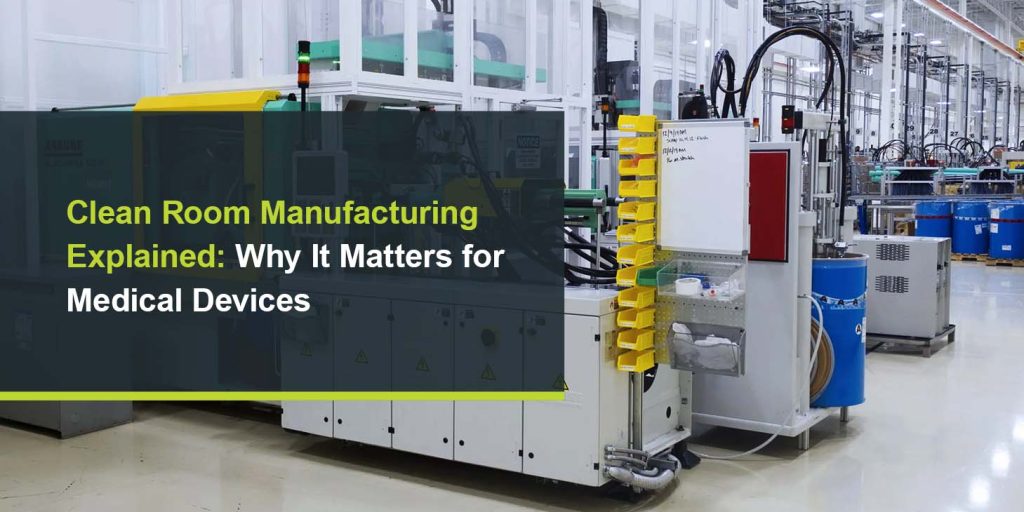
Safety and quality are paramount in the medical device industry. Microscopic particles can compromise device integrity, leading to patient harm, product recalls, and reputational damage. Manufacturers must implement controls that include physical segregation, use of dedicated equipment, rigorous cleaning procedures, and staff training, as required by U.S. Food and Drug Administration (FDA) regulations.
Learn the fundamentals of clean room production, its specific importance for medical-grade Liquid Silicone Rubber (LSR) components, and the standards that govern the process.
Clean Room Manufacturing Explained
Clean room manufacturing is a process that uses a controlled environment to prevent contaminants from damaging sensitive products. It is used in the manufacturing of medical devices and components, where even a tiny particle can cause defects or harm. The objective of a clean room is to provide the most sterile environment possible. This is achieved by carefully controlling the environment where production takes place.
A Controlled Environment
Governed mainly by the FDA’s Quality System (QS) Regulation/Medical Device Current Good Manufacturing Practices (CGMP), the strictly regulated clean room environmental factors are:
- Airborne particle count: The primary classification factor for clean rooms is the concentration of airborne particles. It must meet strict ISO class limits for specific sizes, for example, ≥0.5 μm per cubic meter (m³).
- Air pressure: Clean rooms maintain positive pressure compared to less clean areas to block contaminants, requiring a monitored minimum differential, such as a 0.05-inch water column.
- Temperature: Temperatures between 68° and 72° Fahrenheit (20° and 22° Celsius) ensure process consistency, material protection, and comfort. Exact needs are based on the product and process.
- Humidity: This is typically set between 30% and 50% relative humidity (RH) to prevent microbial growth, electrostatic discharge (ESD), and material changes.
- Microbial contamination: In industries like pharmaceuticals and biotechnology, viable organisms, including bacteria and mold, are strictly controlled and monitored through air and surface sampling.
- Airflow: Air velocity and patterns are controlled to efficiently remove contaminants. Unidirectional flow is used in high-criticality areas like ISO Class 5 aseptic processing zones.
ISO Classifications
The U.S. uses the global ISO 14644-1 clean room standards. The International Organization for Standardization (ISO) rates clean rooms from 1, being the most sterile, to 9, based on the maximum allowable airborne particles per cubic meter.
The following classes apply to the medical industry:
- ISO 5 applications are typically pharmaceutical filling and semiconductor manufacturing, with a maximum of 3,520 particles/m³ (≥0.5 µm).
- ISO 6 applies to aseptic processing and surgical instruments, with a maximum of 35,200 particles/m³.
- ISO 7 is the standard for medical device manufacturing and pharmaceutical packaging, allowing a maximum of 352,000 particles/m³.
- ISO 8 governs general pharmaceutical and medical device manufacturing at a maximum of 3,520,000 particles/m³.
Learn More with Our Clean Room Webinar
Why Clean Rooms Are Critical for Medical Devices
Clean rooms control contaminants to ensure product safety, sterility, and performance. This is especially important for implanted, invasive, or diagnostic devices. Contamination can cause malfunctions, infections, or serious health risks.
Patient Safety
Clean room manufacturing matters for medical devices because it protects patients from harmful bacteria and particles, particularly from sterile, invasive, or implantable devices like stents and catheters. Clean room manufacturing processes also maintain device function and stability by reducing contaminants, which is crucial for accurate diagnostic equipment like imaging systems and glucose monitors.
Regulatory Compliance
Multiple regulatory bodies and standards govern clean room design, operation, and performance. These standards ensure they remain safe and controlled, especially where contamination has serious consequences.
Regulatory standards include:
- ISO 14644: This is the global standard for clean room classifications.
- Good Manufacturing Practices (GMP): These are regulations established by agencies like the FDA, the European Medicines Agency (EMA), and other national bodies. They ensure products are consistently produced and controlled to meet quality standards. GMP guidelines for clean rooms cover environmental controls like temperature, humidity, and particulate contamination. They also cover maintenance, hygiene, gowning, cleaning, and equipment handling to minimize contamination in the production of drugs, medical devices, and sensitive products.
- The FDA: FDA clean room guidelines for pharmaceuticals and medical devices align with GMP requirements. FDA regulations 21 CFR Part 210 and 211 specify requirements for air quality, environmental controls, and sterilization.
Examples of Devices
Examples of products that require clean room manufacturing include:
- Surgical instruments and devices
- Pharmaceutical products
- Biotechnology products
- Parts and products used for diagnostics
- Medical devices that contact the body
- Fluid management and drug delivery devices
- Respiratory products
- Nanotechnology and microelectronic components
Read Our Wearable Device Case Study
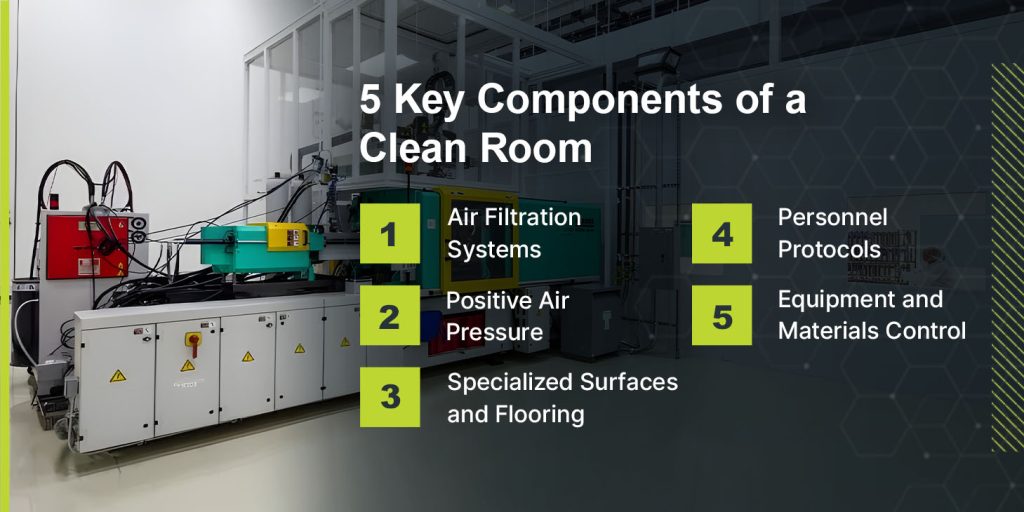
5 Key Components of a Clean Room
Depending on the class required, a clean room necessitates careful design to be certified compliant with industry standards.
1. Air Filtration Systems
High-efficiency particulate air (HEPA) and ultra-low particulate air (ULPA) filters trap airborne contaminants in dense fibers through interception, impaction, and diffusion. The main difference is filtration efficiency and particle size. ULPA filters capture finer particles than HEPA filters.
2. Positive Air Pressure
Clean rooms use positive pressure by supplying more filtered air than is exhausted. This pressure pushes clean air out when doors open, preventing contaminants from entering. The maintenance of positive pressure relies on a precisely controlled heating, ventilation, and air conditioning (HVAC) system design and several structural features like excess air supply, controlled exhaust and return, pressure monitoring systems, and air locks and self-closing doors.
3. Specialized Surfaces and Flooring
Surfaces and floors are smooth, non-shedding, and easy to clean to minimize contaminants. Materials are selected based on cleanliness standards, the type of cleaning chemicals used, and the facility’s specific needs.
Typical materials include stainless steel, powder-coated steel or aluminum, and specialized plastics. The main flooring options are epoxy or polyurethane resin, sheet vinyl, and conductive/static-dissipative flooring.
The design of the room is crucial, as well:
- Joints and seams are sealed with epoxy or silicone to prevent particle buildup.
- Curved junctions eliminate sharp edges and crevices where contaminants may collect.
- Ceilings contain filters, lighting, and ventilation — blank panels fill unused spaces.
- Tempered window glass panels are mounted flush with the wall for visibility and to avoid ledges.
4. Personnel Protocols
Clean room staff follow strict hygiene, multistep gowning, limited movement, and cleaning protocols to prevent contamination. They must wear clean room garments, avoid wearing cosmetics and jewelry, wash their hands thoroughly, and move slowly to minimize the release of particles.
Before entry, staff put on full attire and wipe down all tools. Inside, they follow airflow patterns, avoid unnecessary contact, and never pick up dropped items.
5. Equipment and Materials Control
All tools and materials brought into a clean room must be meticulously selected and cleaned to maintain the strictly controlled low-particulate environment. Contamination prevention relies on specific procedures for all items entering this sensitive space.
How Clean Room Manufacturing Works With LSR Injection Molding
LSR is an advanced material widely used for medical devices due to its superior properties. These include:
- Implantable devices like heart valves, stents, and breast implants
- Tubing and respiratory devices like catheters, respiratory masks, and medical tubing
- Seals and gaskets, like valve seals, and seals for dialysis machines and infusion pumps
- Surgical and drug delivery devices like grips and actuators, and drug delivery components like plugs, septum and seals for syringe and injection devices
- Healthcare wearable devices used for CGM monitoring and insulin delivery
The clean room environment is particularly critical when working with LSR for these reasons:
- Biocompatibility: To maintain LSR’s inert and hypoallergenic properties, the molding process must be free of contaminants that could be transferred to the part.
- Sterilization: Clean room-molded parts have a lower bioburden, making final sterilization processes more effective and reliable.
- Precision parts: For high-precision components and micro parts like thin membranes, seals, catheters, and over-molded devices, a particle-controlled environment is essential to prevent microscopic flaws that could adversely affect performance.

Choosing a Clean Room Manufacturing Partner
Clean room manufacturing is important for medical devices; however, selecting the right partner is as important or even more important than the clean room process itself. Look for a qualified manufacturing partner with an ISO 14644 certified clean room, and with an ISO 13485 quality management certification. They should have in-depth experience in silicone materials, a controlled and stable molding process, advanced automation for a higher degree of consistency and contamination control–especially for high-volume projects, and expertise in medical molding.
Consider a partner who can manage the entire process, from early design and prototyping, through tooling, molding and secondary processes, all within a controlled environment. Contact SIMTEC Silicone Parts today to discuss how our certified ISO Class 8 clean room and automated LSR injection molding processes can ensure the quality and compliance needed for your medical device components.